FOOD COURTS MADE FOR FOODIES: GATHER, CONNECT, AND ENJOY
78% of guests stay longer in food courts with thoughtful zoning and a welcoming atmosphere.

78% of guests stay longer in food courts with thoughtful zoning and a welcoming atmosphere.
Create a memorable experience for your guests through design solutions that combine atmosphere, functionality, and business goals.
Refresh your existing space while saving up to 30% of the budget compared to a full renovation.
Equip your space with everything it needs — we will help select tableware, cutlery, and equipment that fit your concept and connect you with reliable suppliers for smooth operations.
Optimize your launch costs — we’ll help shape the budget, return-on-investment hypotheses, and payback strategy to ensure your project’s financial efficiency and stability.

• 15+ years of experience in commercial design with completed projects across 4 continents
• AI-powered analytics for efficient space usage
• Staying within budget and ensuring full cost transparency
• Solutions tailored to your corporate culture and brand goals
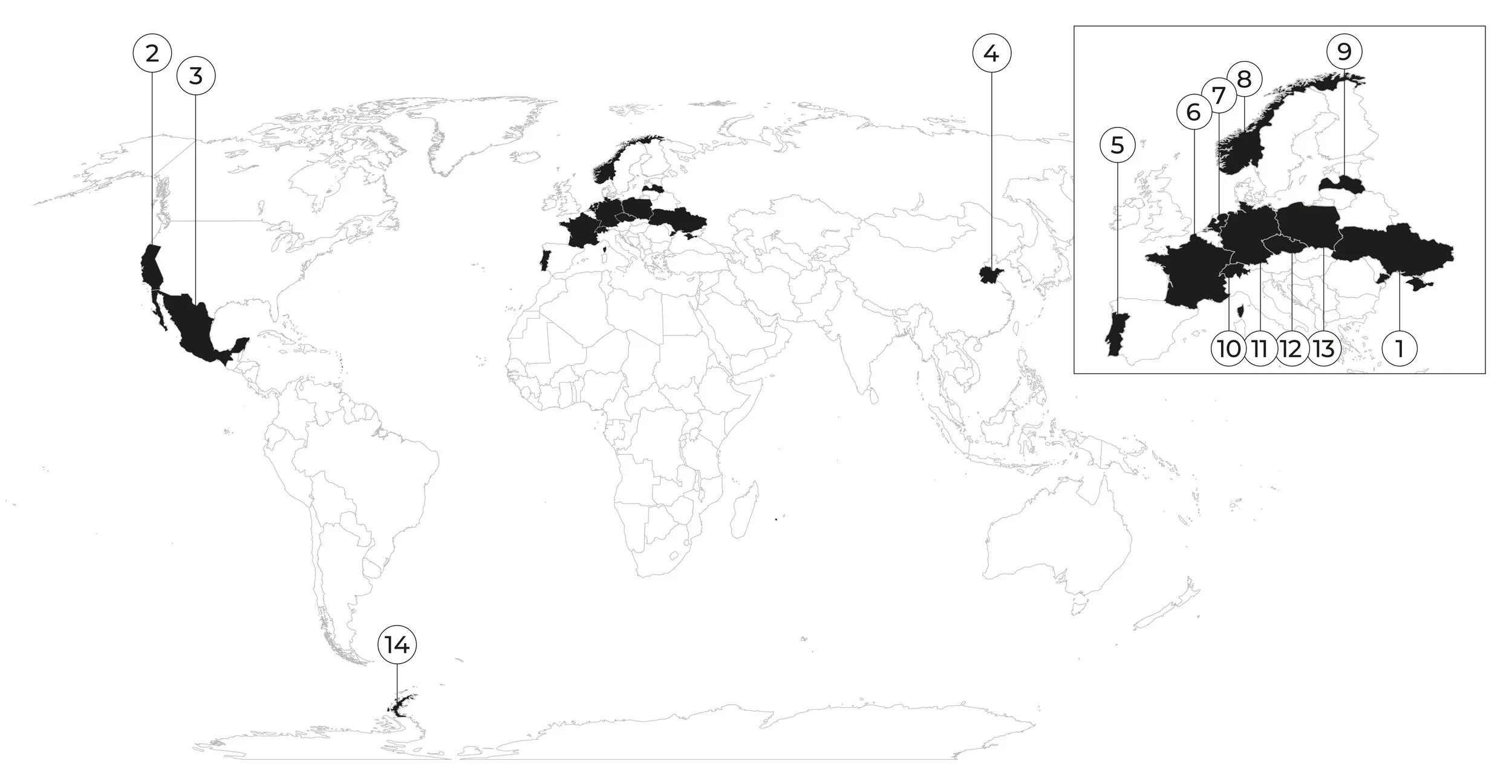
Our projects around the world

Our clients

Our awards

KYIV FOOD MARKET / food hall
2000 sq.m, Kyiv, 2019
The Architecture MasterPrize
Commercial Interior Winner | Year: 2020
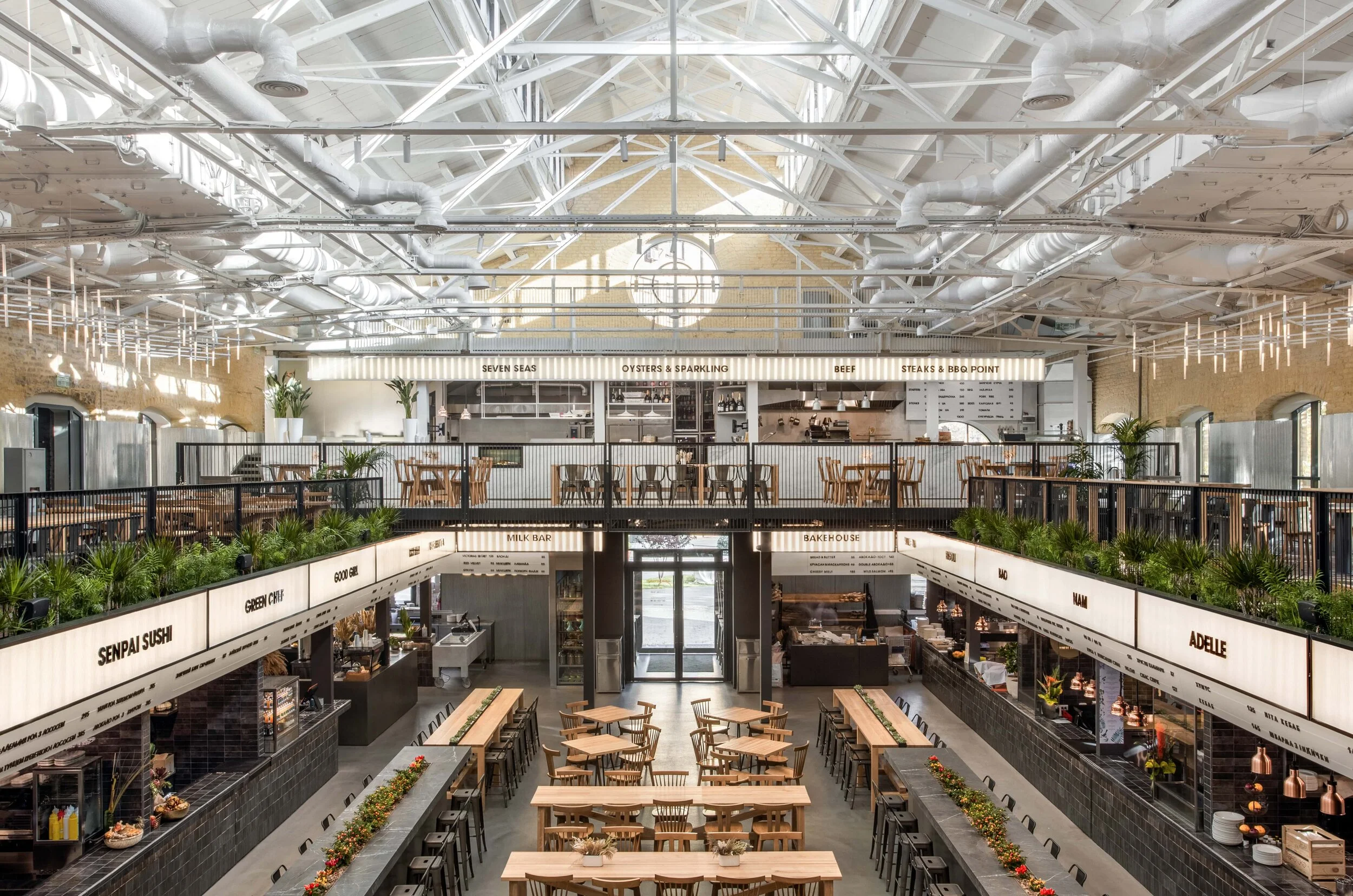
Kyiv Food Market is located in a former 18th-century military arsenal. The task was to transform this industrial site into a modern food hall while preserving the building’s architectural authenticity. The food court is arranged in a closed circle around a central atrium that seats 300 guests. The second floor houses a wine bar, show kitchen, and a communal dining hall, while the third floor offers a viewing platform overlooking the Arsenalna metro station.

ODESA FOOD MARKET / food hall
970 sq.m, Odesa, 2020
Odesa Food Market is a renewed space located in a former cinema building. After three years of operation, the food court has adopted a new format that meets the modern needs of its guests. At the heart of the concept is the person — a visitor who comes not only for food but for atmosphere. Natural materials, lush greenery, and a subdued palette create a sense of sincerity and comfort. The space is organized around the main hall with an olive tree, a bar, and several levels of food courts that flow seamlessly into one another. Odesa Food Market demonstrates how architecture can refresh a gastronomic space while preserving its authenticity and adding a sense of maturity.
The concept of a food court has undergone significant changes nowadays. People no longer want to eat in boring, bright basements of shopping malls. They want something better. They want a food hall – a place that feels comfortable, stylish, and social.
For business owners and developers, the main question is: How do you build a food court where people actually want to spend time?
Today, successful food court design is not just about putting many chairs in a room. It is about creating a good atmosphere. Whether you are building a new market or planning a food court renovation, the goal is the same: make a space where guests want to stay, eat, and talk.
At balbek bureau, we treat commercial interior design food court projects like small cities. We plan them so thousands of people can move around easily without feeling crowded.
Based on our experience with big projects, here are the main rules for a functional space:
Organizing the flow – the most important part is how people move.
Guest flow: It must be simple. Guests should not block the way for other guests.
Service flow: Cleaners and trash collectors should have their own paths, so they don't disturb the diners.
Delivery flow: Food delivery is huge now. Modern designs need a special zone for couriers to pick up food without crowding the seating area.
Different types of seating – don't use the same table everywhere. Different guests have different needs:
Big tables: For large groups of friends.
Bar stools: For people eating quickly or alone.
Soft sofas: For people who want to relax or work.
Noise control and comfort – the biggest problem in old food courts is noise. It is hard to talk when plates are crashing and people are shouting. We use special acoustic materials on ceilings and walls to absorb sound. Also, we always add power sockets for phones and laptops.
Many malls have outdated food courts. A food court renovation is the best way to bring customers back.
You don't always need to destroy the building to fix it. Often, we can change the feeling of the space by:
Better lighting: Changing cold office lights to warm, cozy lighting.
Real plants: Adding big trees or plants makes the air better and the space softer.
New furniture: Replacing plastic chairs with wood, metal, or soft fabrics.
The challenge: We had to transform Building No. 5 of the old Military Arsenal (built in the late 18th century). It was a cold, empty industrial space. The goal was to gather the best Kyiv restaurants under one roof.
The solution:
Architecture & zoning: We wanted to keep the history alive, so we kept the original brick walls and the massive roof trusses.
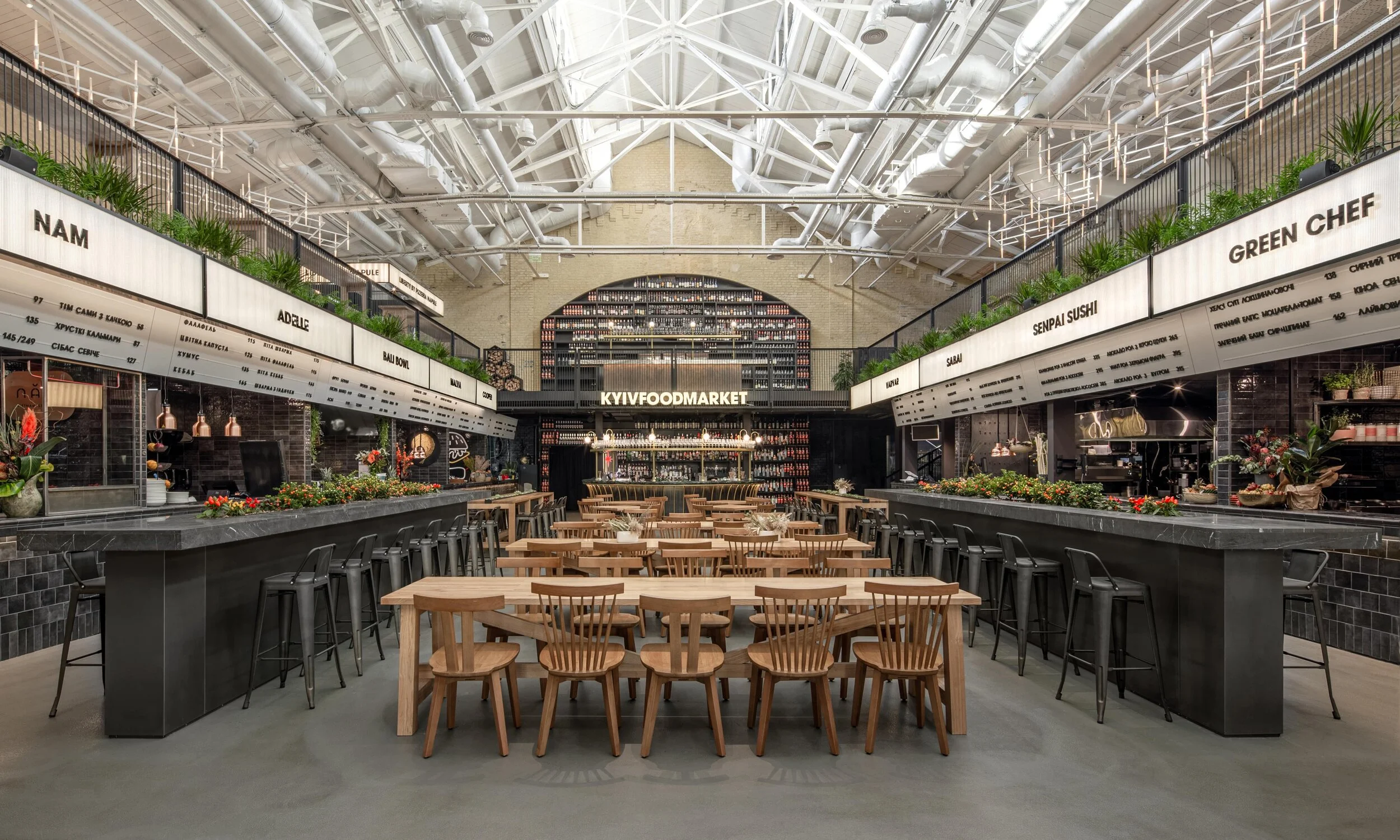
The layout: We placed the food units in a circle along the walls creating a large atrium in the center with 300 seats.
Hidden tech: The old building had no pipes or cables. We hid all the engineering underground so the visual space remained clean.
The roof: We restored the original roof and opened the skylights to let natural light flood the hall.
Level 1: Main Hall – the ground floor is for energy and movement.
Furniture: We used high bar counters and long "communal" tables (minimum 4 seats). This encourages strangers to sit near each other and talk.
Materials: The food counters are lined with textured tiles. The standing counters are made of matte dark marble and steel.
The Highlight: A unique round bar with a green marble tabletop.
Level 2: We built a second floor for a quieter atmosphere.
Seating logic: We mixed two types of seating: standard tables for four people and large communal tables.
The Show Kitchen: This level houses a separate, enclosed room. The "Show Kitchen" is a multi-functional space: it is used for cooking master classes, private presentations, or special events, allowing for a focused experience separate from the main hall.
The chandelier: A massive custom light fixture made of 6 sections hangs above the tables. It uses thin acrylic tubes to diffuse soft light downwards.
The result: Kyiv Food Market became a city landmark. It proved that adaptive reuse can turn an abandoned historical building into a thriving modern business. It is not just a place to eat, but a "third place" where the community gathers.
Read more about Kyiv Food Market.
Bad ventilation: If guests smell frying oil in the seating area, they will leave. Good air systems are priority #1.
Boring lighting: If the light is the same everywhere, it feels flat. We use shadows and spotlights to create an atmosphere.
Bad navigation: Guests should easily find the toilet or the tray return station.
Weak materials: Using cheap materials is a mistake. Commercial interior design food court projects need very durable floors and fabrics that can survive thousands of visitors every day.
We design for people. We don't just build walls – we build experiences. Our philosophy is human-centric design. We analyze how guests feel, how they move, and what makes them comfortable. Whether it is preserving the soul of a historical building or creating a new community hub, our goal is to make a space that people love to use, not just look at.
Experience with scale: We know how to work with very large spaces (2,000+ square meters).
Renovation experts: We are good at turning old, industrial buildings into modern places.
Full service: We plan everything: from the logistics and kitchen zones to the color of the sofas.
Have a project in mind? We would love to hear about it.
Fill out the form and we will contact you within 24 hours.
The trend is moving away from "Fast Food" to "Food Halls." This means better food quality, industrial-style design, lots of plants, and self-ordering screens.
Renovation has unique constraints (existing walls, pipes), but for us, it is a standard challenge. We specialize in adaptive reuse. We know exactly how to transform an old space into a modern destination without unnecessary demolition, making the process smooth and efficient for the client.
We use strong air extraction in the kitchens and "air curtains" to keep the smell inside the kitchen, not in the dining hall.
Yes. We use different lighting. Bright light for lunch (energy), and lower, warmer light for dinner (intimacy).
Materials must be very durable. We use stone tiles, hard vinyl, metal, and solid wood. They must be easy to clean and hard to break.
Of course! However, our experience shows that even the most motivated clients often face hidden risks, inefficient solutions, and missed opportunities.
We design beauty salons that don’t just look good but truly work — for teams, processes, and brands. This requires analytics, systematization, attention to detail, and consideration of hundreds of factors: from workflow scenarios to the ergonomics of the reception area.
We help you save your resources — time, money, and energy — and transform the space into a business growth tool, rather than just a collection of furniture in square meters.
Yes. If you add power outlets and good Wi-Fi, the food court becomes a coworking space during the day. This brings you more customers in quiet hours.